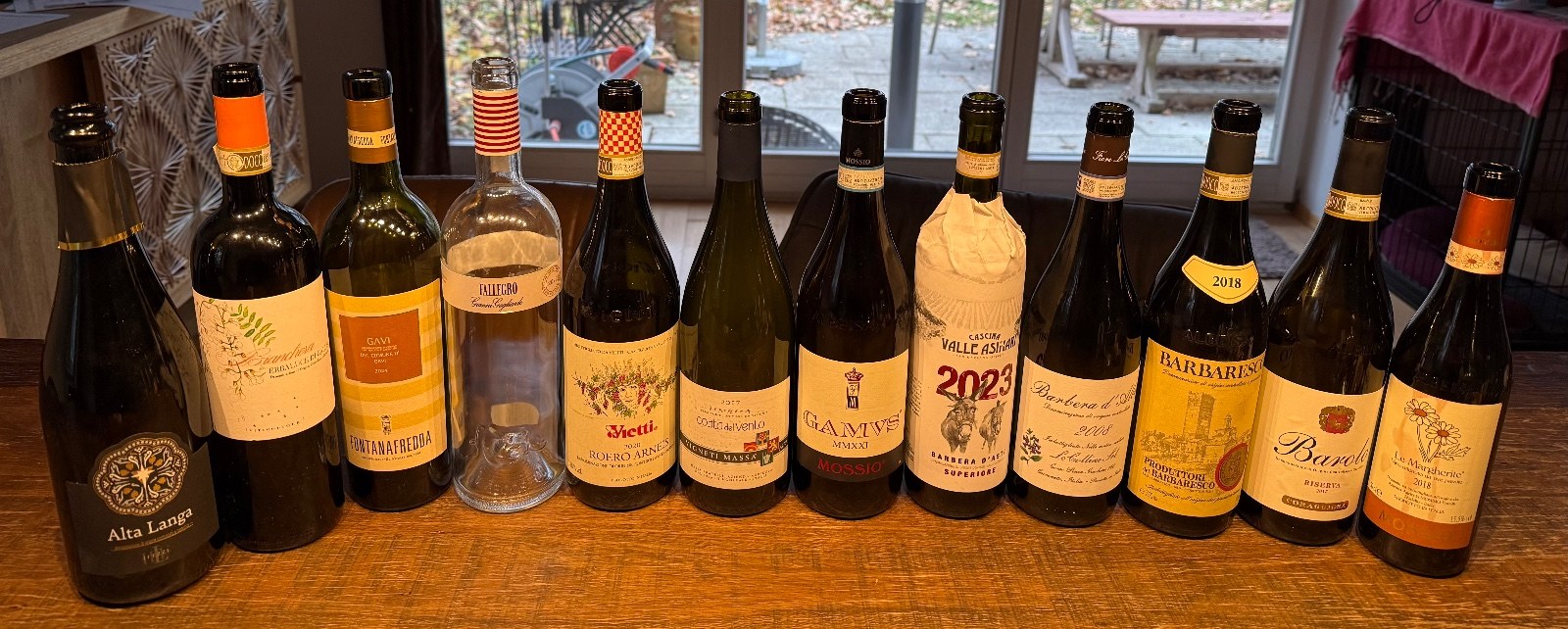
Grissini, truffles, hazelnuts – and twelve wines from one of the world’s great wine-growing regions.
This time we travelled to Piedmont: a region at the foot of the Alps with a long history of winemaking. Nebbiolo is mentioned in a document dating back as far as 1268, and since 2014 the wine-growing landscapes of Langhe, Roero and Monferrato have been a UNESCO World Heritage Site. Twelve wines were on the programme, ranging from sparkling wine to fresh and full-bodied whites, right through to Barbaresco and Barolo. A few pairs of wines ran like a common thread through the evening: two Barberas (young and matured), two Nebbiolos (Barbaresco and Barolo) and two Mossios (dry and sweet).
Kick-offWe
began with Paolo Avezza’s Alta Langa 2021, a classic bottle-fermented sparkling wine from the high-altitude vineyards of the Langhe. This was served with grissini – invented in Turin – and small pieces of guanciale.
The white wines
- Orsolani ‘Bianchera’ Erbaluce di Caluso 2023 – served with a white bean salad with red
onions - Fontanafredda Gavi del Comune di Gavi 2024
- Gagliardo ‘Fallegro’ Langhe Favorita
2022 – with Vitello
Tonnato – Vietti Roero Arneis 2020 – Vigneti Massa ‘Costa del Vento’ Timorasso 2017 – with risotto and pan-fried king oyster mushrooms
Piedmont’s white wines are less well known than its reds, and quite unjustly so. The Erbaluce from the Canavese region north of Turin has a crisp acidity, whilst the Gavi is the classic among the region’s whites. Favorita is a Piedmontese variant of Vermentino, and Arneis would have all but disappeared were it not for winemakers such as Vietti. Finally, there was the Timorasso from Walter Massa. He practically single-handedly saved the grape variety. Having spent almost ten years in the bottle, the wine has demonstrated just how well a white wine from Piedmont can age.
The red wines
- Mossio ‘Gamvs’ Dolcetto d’Alba Superiore 2021
- Cascina Valle Asinari Barbera d’Asti 2023 – with cured meats and
cheese – Le Colline Barbera d’Alba 2008 – also with cured meats and
cheese – Produttori del Barbaresco, Barbaresco 2018 – with pasta and (black)
autumn truffles – Coraggiosa Barolo Riserva 2015 – with Castelmagno and honey
The Dolcetto is the wine people drink every day in Piedmont: fruity, smooth and uncomplicated. This was followed by a direct comparison of the two Barberas: a young one from Asti and an 18-year-old from Alba. It demonstrated just how much the grape variety changes over time. The evening concluded with a Nebbiolo. The Barbaresco was from the Produttori del Barbaresco, who carry on the tradition of the first cooperative winery founded in 1894, and was served with freshly shaved autumn truffles (unfortunately, I couldn’t get any white ones this time). This was followed by a 2015 Barolo Riserva with Castelmagno and honey. After all, November in Piedmont simply isn’t the same without truffles.
FinaleWe finished
on a sweet note: Mossio Fratelli ‘Le Margherite’ Passito 2018, served with roasted Piedmont hazelnuts. The Tonda Gentile hazelnut variety is protected under the name ‘Nocciola del Piemonte’.
Grazie mille to everyone who joined us!